The Farmland Debate Should Start with Consideration for Farm Families
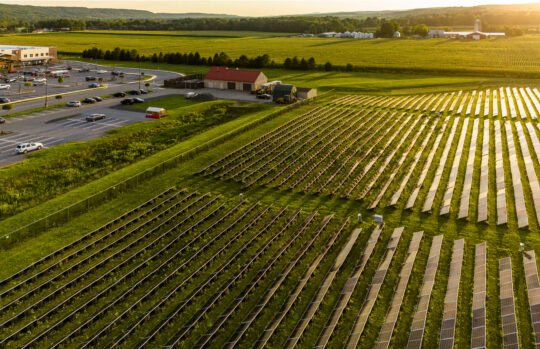
Insights from Kevin Smith, CEO of Cypress Creek Energy
“The conversation about solar usually begins with the number of acres of farmland. Maybe it should begin with the farm families who depend on them.”
America’s family farms have helped feed and power this country for generations.
Every time a new solar project is proposed, the debate naturally turns to the land. That’s understandable. But it may also be causing us to overlook what those same projects can help preserve.
Family farms across the country are under enormous financial pressure, and rural America needs new sources of long-term investment. At the same time, electricity demand is growing at a pace not seen in decades, and we need to bring new power online quickly to keep the lights on and electricity costs affordable.
I think it’s worth taking a step back and considering those challenges together.
The question isn’t whether solar uses land. The better question is how much land it actually uses, and whether we’re putting that land to work in ways that create stronger farms and a stronger America. Keep in mind that solar currently occupies less than 1/10 of 1% of the total farmland in the U.S., leaving 99.9% of the land for food production.
Think about that.
Across the country, farmers are facing one of the toughest economic environments in years. Chapter 12 farm bankruptcies rose 46% last year. Farm debt continues to climb toward historic highs. Rising input costs, volatile commodity prices including fuel costs, unpredictable weather, and high interest rates have made it harder for many farm families to do what previous generations often took for granted: keep the farm in the family.
Against that backdrop, it’s worth asking another question: If a solar lease on a portion of the farmer’s land helps keep a family farm in business, isn’t that also preserving farmland?
Keeping Farms in the Family
For many farm families, the decision to lease a portion of their land for solar isn’t about getting out of agriculture.
It’s about staying in it.
A solar lease provides something farming often can’t: a source of diversified income that is dependable, long-term and that isn’t tied to rainfall, commodity prices, input costs, trade policy, or volatile markets. Year after year, it provides a reliable source of revenue that helps reduce uncertainty and gives farm families greater financial stability to keep the land with the family and continue to farm the balance of their land.
That stability matters.
It can help farmers manage difficult years without selling land that’s been in the family for generations. It can strengthen relationships with lenders, making it easier to finance equipment, improvements, or expansion. It can fund their children’s education or help pay for medical bills. And it can provide the confidence to keep investing in the future of the farm rather than simply trying to survive the next season.
And research suggests that this dependable income from leasing a portion of their land for solar isn’t driving farmers away from agriculture. It’s helping many stay in it.
A recent Cornell University study found that the overwhelming majority of farmers who received solar lease payments weren’t walking away from agriculture. They were using that dependable income to continue farming, invest in their operations, and, in many cases, expand them.
There can be another benefit, particularly in water-constrained regions. Solar projects use very little water during operations. When a portion of farmland is leased for solar, that can allow farmers to direct limited water resources toward the land they continue to farm. It can also open up water supply for other farmers in the area that are facing water constraints.
That’s an important part of the farmland conversation. Preserving farmland isn’t only about protecting acres. It’s also about creating the economic conditions that allow farm families to keep farming and pass their land to the next generation.
Putting Land Use in Perspective
The public conversation often makes it sound as though solar is consuming large amounts of America’s farmland.
It isn’t.
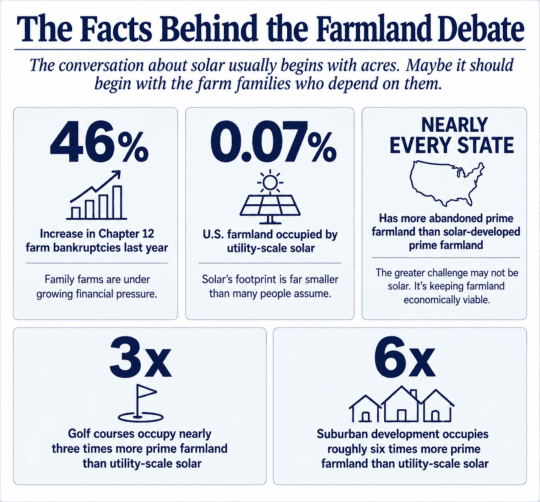
According to a comprehensive analysis by the Solar Energy Industries Association, utility-scale solar currently occupies just 0.07% of U.S. farmland, and there isn’t a single state where solar uses more than 0.5% of its prime farmland.
One finding particularly stood out to me. Nearly every state has more abandoned prime farmland than solar-developed prime farmland.
Think about that for a moment.
Earlier, I mentioned that farm bankruptcies rose 46% last year. If we want to preserve farmland, we can’t focus only on the land itself. We also have to focus on the economic realities facing the families who farm it.
The comparisons provide even more perspective.
Golf courses occupy nearly three times more prime farmland than utility-scale solar. Suburban development occupies roughly six times more.
And even in the highest land-use scenarios studied by the U.S. Department of Energy for 2050, if all new solar were built on farmland, which is highly unlikely, it would affect less than 1.2% of current farmland.
Golf courses and suburban development rarely become the center of a national conversation about preserving farmland. And there’s another important distinction: unlike other forms of development, solar doesn’t permanently remove land from agriculture. At the end of a project’s operating life, the land can be returned to farming if that’s the best use for it in the future. Once farmland is converted to suburban housing and development, it’s lost to farming forever.
And solar doesn’t have to mean the land stops working.
Thoughtfully designed projects allow the land to keep working in different ways while generating electricity from solar throughout the life of the project while preserving it for future agricultural use.
Most people picture a solar project and imagine the entire site covered by solar panels. An aerial view tells a different story.
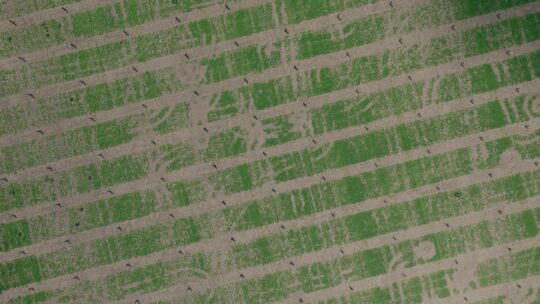
Those tiny black dots scattered across the field are the steel piles that will support the racking and solar panels. Seeing them from above reinforces something that’s easy to miss. The piles occupy only a small portion of the site, leaving more than 90% of the land available for permanent vegetation beneath and between the spaced rows of solar panels.
That vegetation isn’t just there to fill space. It improves soil health, reduces erosion, supports pollinators, and provides habitat for birds and other wildlife. At some sites, sheep graze among the arrays, allowing agricultural and energy production to coexist.
To me, the photo puts the land-use question in perspective. What may appear to be a field covered by solar is actually land that remains largely open and available for vegetation.
What Preserving Farmland Really Means
Looking at the research reinforced something I’ve long believed: the best decisions aren’t guided by assumptions or ideology. They’re guided by facts.
Those facts led me to think more broadly about what it really means to preserve farmland. It’s not just about protecting acres. It’s about protecting the families who farm them.
We all want family farms to succeed. We all want productive farmland. We all want affordable, reliable electricity. We all want future generations to inherit more opportunity, not less.
Those goals don’t have to compete.
Solar projects won’t be right everywhere, and they shouldn’t be. Every community and every piece of land deserves careful and thoughtful consideration.
But perhaps it’s time to broaden the conversation. What if the choice isn’t whether farmland should produce food or energy? It’s how we can help it do both.
About Cypress Creek Energy
Cypress Creek Energy is a U.S. independent power producer and developer of energy infrastructure designed to meet the nation’s rapidly growing demand for reliable, cost-effective, and sustainable electricity. Built on more than a decade of experience developing, financing, owning, and operating energy assets, the company delivers integrated solar, storage, and firm capacity solutions that serve utilities, communities, and large-load customers.
Cypress Creek believes energy infrastructure should create lasting value beyond generating affordable, sustainable electricity. Through responsible development, long-term ownership, and meaningful community partnerships, the company is committed to strengthening the places where it lives, works, and builds. Since inception, Cypress Creek has commercialized 19 GW of projects and today has more than 6.8 GW of assets operating or under construction, along with a 19 GW development pipeline. Through Cypress Creek Solutions, its in-house operations and maintenance platform, their experienced team manages more than 8.6 GW of energy assets for both Cypress Creek and third-party owners across 24 states.